
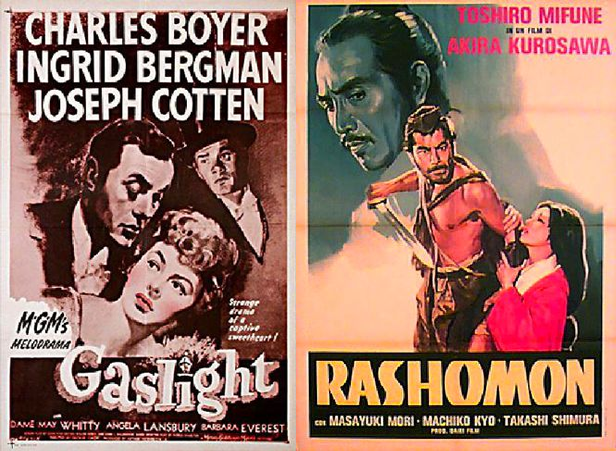
I’ve never liked the term gaslighting. In case you’re not aware, the term comes from the 1944 motion picture Gaslight, directed by George Cukor, a studio director at RKO Radio Pictures. In the film, the villain, Gregory Anton, convinces the victim, Paula Anton, that she is loosing her mind by incrementally dimming the gas lighting in the house all the while insisting that nothing has changed. Naturally, he’s after the inheritance. Naturally, he gets his comeuppance in the end
It’s a diverting melodrama, with cartoonish villains and helpless heroines.
And almost no one in the real world behaves that way. To truly gaslight, is to deliberately and maliciously try to convince someone that they are crazy for believing what they do, or not believing what the manipulator desires. It is the nefarious example of of the Marx brothers skit, “who are you going to believe, me or your own eyes.“
When you accusing someone of gaslighting, you are not accusing them of misremembering something, or even remembering with advantages. You are accusing them of deliberate, calculated evil.
The widespread use of a term like gaslighting around creates the impression of a culture teeming with master manipulators. But in reality, the truth usually much more banal. We just lie a lot. But we seem to crave the drama implicit in gaslighting. People seem to enjoy it as a form of dark entertainment. Maybe it’s related to how there is always a traffic jam so people can rubberneck the wreckage.
And where there is entertainment, there are profits to be made.
Social media influencers, who live by impressions and clicks, have stepped into this role. And to understand how, I need to digress a bit and discuss the idea of “parasocial relationships.” These are one-sided dynamics where a social media follower feels a deep, personal friendship with a content creator who is unaware of them as an individual. From this position of unearned intimacy, influencers can and do pathologize normal human behaviors to keep their audience hooked.
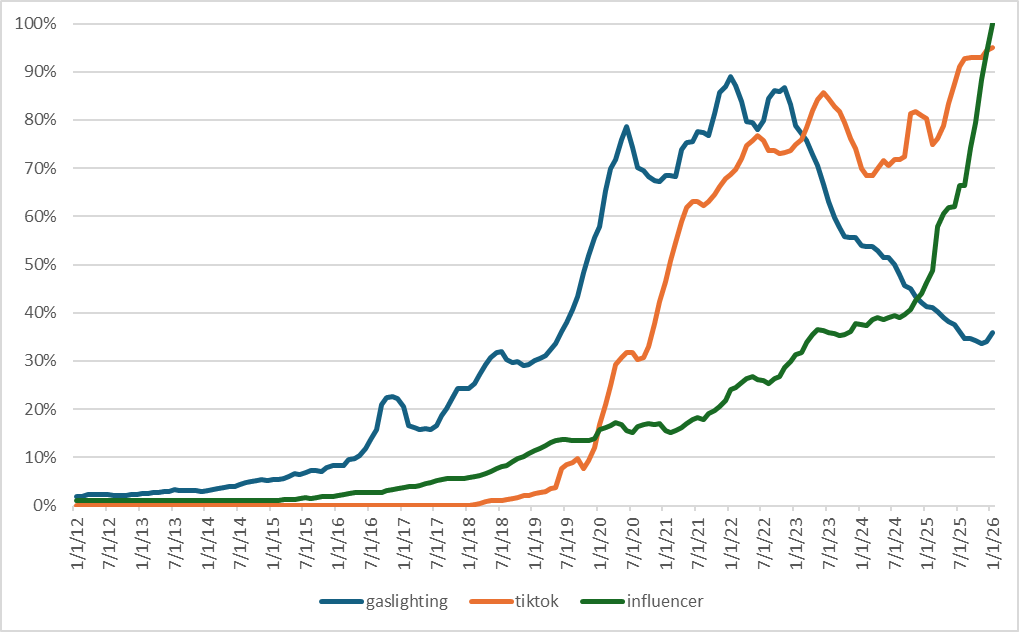
To see how this works, lets look at the interactions of “gaslighting,” “TikTok,” and “Influencer” as reported by Google Trends.
Source https://trends.google.com/trends/
The blue line that rises first it the term “gaslighting,” which really started to take off in 2016. This was about the time that Kelly Ann Conway was talking about Alternative facts, and saying that the crowds at Trumps first presidential inauguration were larger than those of President Obama’s.

Source: thedemlabs.org
It clearly was not, so there needed to be a word for “who are you going to believe, me or your own eyes.” Gaslighting, which had been in the background for several years, became that term. And it was appropriate – these people were trying to convince everyone that their “alternative facts” were the True Facts. For once, outside of fiction, there was a concentrated effort to gaslight.
But it didn’t stay that way. Gaslighting was a seductive term that could be used to describe other forms of manipulation. If your lover didn’t remember an event the same way you did, then they were gaslighting you, at least according to the rapidly emerging influencer industry. The term seems to have reached its peak as TikTok hit its stride in the early 2020’s. But the ideas have their own particular lifecycle, and by 2023 gaslighting had become embedded enough in the culture that it couldn’t be used to get attention any more, and the influencers (and TikTok) moved on to other more novel ideas that have emotional power, such as the carnivore diet and seed oil. Which leads us to the last line, “influencer.”
Gaslighting seems to have been a proving ground for how influencers and recommender algorithms could interact to create maximum engagement. It created a feedback loop of gaslighting narratives, driven entirely by engagement algorithms that reward emotional responses such as outrage. And this seems to be a good strategy for maximizing clicks. When I write this, the “influencer” line is rising with no end in sight.
As platforms pushed gaslighting relationship stories to the top of our screens, audiences were conditioned to see this kind of psychopathy in every routine disagreement and misunderstood text message. It’s important to remember that relentless repetition manufactures the illusion of objective reality. While conflicting recollection and even lying are common in interpersonal relationships, malicious manipulation is comparatively rare.
We need to remember that human deception is overwhelmingly driven by benign, protective, or socially evasive instincts. Literally, the primary reason we lie is to make someone feel better. This kind of lying is pervasive, ranging from parents affirming that Santa Claus is real to a distressed child, to responding with an emphatic “no!” to the question “does this make me look fat?” That being said, there are a few people who tell lies for the sheer thrill of manipulation and outwitting others. But it’s a small number – a mere 9.3% of individuals sampled in this study. Today, we know these people as “Trolls.”
But a lot of people believe that gaslighting is pervasive. Approximately 80% of young adults perceive themselves to have been the explicit targets of gaslighting. The perception of gaslighting is wildly disproportionate to the actual occurrence.
Why would that be? I think that our digital ecosystem rewards sensationalism and intense emotional narratives to drive engagement and increase views. And the idea of gaslighting is exciting. Enough to base a movie on. Run-of-the-mill lying, as a defensive behavior, or just part of simple interpersonal can’t compete.
What this means is that the threshold for what constitutes psychological abuse is lowered in the public consciousness, transforming many deceptive or disagreeable encounters as a profound psychological attack.
The tragedy is that psychological attacks increase the likelihood of clicks, which creates perverse incentives. As a result, our recommender algorithms systematically work to convince us to believe in a reality that doesn’t actually exist.
If anything is gaslighting us, it’s the algorithms that curate our feeds.
There is another movie, that is a better fit to what many of us mean when we accuse someone of gaslighting.

That movie is Rashomon, by one of the great directors of all time, Akira Kurosawa.
Rashomon was released in 1950 and filmgoers at the time had never seen anything like it. There are only three locations. The acting is stylized, The soundtrack is spare. And the story is is not a story with a single clear perspective. The film is ostensibly about the the murder of a samurai and the rape of his wife in a forest grove, told in an exchange between a priest, a woodcutter, and a commoner taking refuge from the rain under the ruins of the Rashomon gate. But unlike virtually every film before it, there is no objective view of the events. Instead, Kurosawa presents four wildly contradictory testimonies from the people involved, including a bandit, a woodcutter, the victim’s wife, and even the dead samurai speaking through a medium.
Every single account is different, warped by the teller’s ego, shame, or self-interest. The bandit is a hero who kills the samurai in a fair fight. The wife confesses to killing her husband. The dead man reveals that he killed himself. The woodcutter says first that he saw nothing, but later describes a clumsy, panicked fight between the bandit and the samurai. In that version, the bandit is goaded into killing the man by his wife.
This reflects research on the motivations for lying. The characters in the film are lying for the most basic and common of reasons: “to avoid feelings of shame or judgement; to create a positive self image” or “to avoid getting into trouble.” These people aren’t spinning calculated webs of psychological torture to break each other’s minds; they are simply flawed humans, creating a subjective experience “to make them feel they are better people than they really are.” Do they know that they are doing this? Sometimes. The woodcutter explicitly states that his first story, where he saw nothing, was to keep from getting involved. He lies to protect himself. The bandit lies to inflate his self image. None of these people seem to have any plan on how they intend to lie. Rather, these are lies in the moment that help the participants make sense of a terrible event – a murder – in a way that helps them deal with it.
The point of Rashomon is that everyone has their own version of the truth. The most important part of the film, in my opinion, is that there is never a final definitive answer or what happened. We must assemble our own, potentially flawed representation. The lesson of Rashomon is that every narrator is subjective, and the best way to approach the truth by listening to all the points of view, and incorporating those aspects that create a coherent pattern of events the best. One story may be the most compelling or exciting, but the common elements across all stories are the most likely to be true.
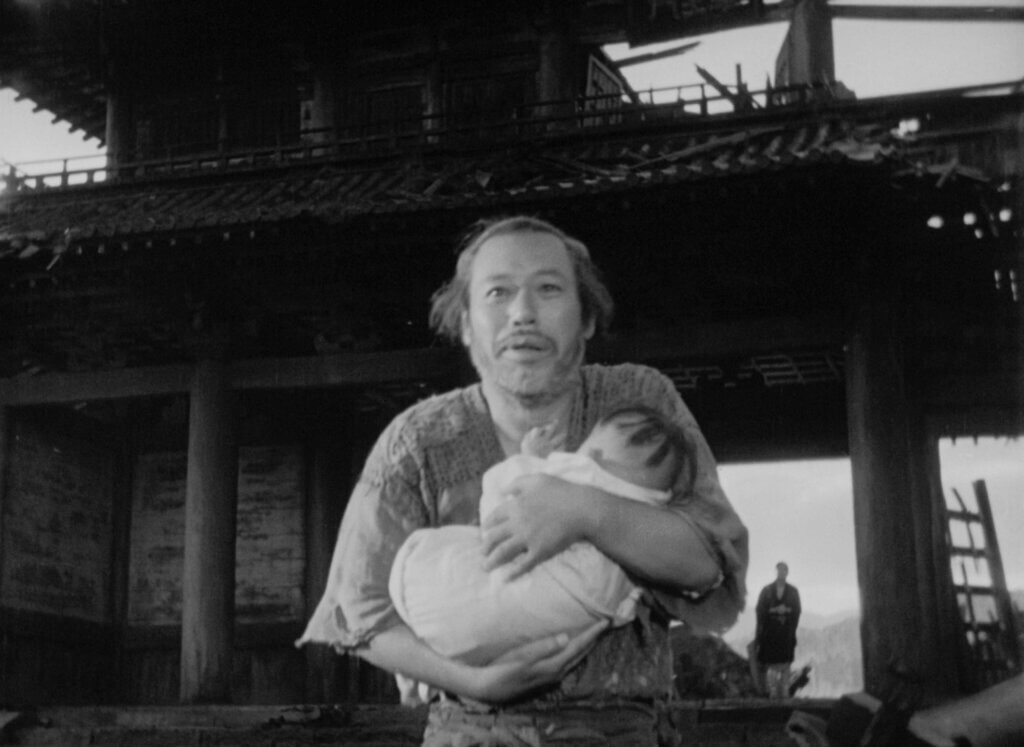
At the end of the film, after all the stories have been told, the film switches gears. The priest and the woodcutter, who have been discussing the stories hear the sound of a baby wailing. The commoner has found and abandoned child and is taking its komono. The theme of the film briefly repeats, with the commoner accusing the woodcutter of taking the murdered samurai’s dagger. But this time the woodcutter appears to admit the truth, hanging his head in shame. The priest moves to take the child to the temple, but the woodcutter stops him and takes the child, saying that he and his wife “already have six, and would hardly notice another.”
The film ends with the woodcutter walking away from the temple as the rain stops, carrying the baby in his arms. And I think that this is the center of the film. Throughout the story, the film has been shot from an objective, mostly static perspective. We are observing the lies from a metaphorical distance. But here the perspective changes, the camera moves with the woodcutter as he walks away from the temple. His words may have been deceitful, but his actions are true and noble. Kurosawa seems to be saying that people always lie, so base your opinions on those things that you see, not those things that you si mply hear about.
There are no villains in the Rashomon world, there are only people with incomplete, biased, and perspectives that are more self-centered or less self centered. But we cannot judge them on their woards, because our words are incomplete, biased, and self-centered. Actions matter more.
Think about that the next time you want to accuse someone of gaslighting.

